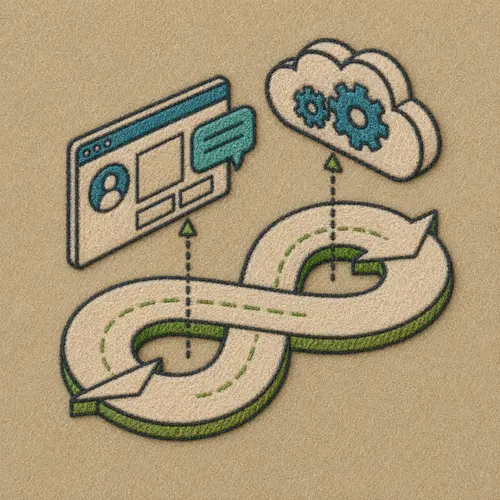

Distributed work does not create weak operating systems. It exposes them. When a team depends on proximity to notice work, clarify ownership, build trust, or resolve ambiguity, distance simply removes the informal scaffolding that was already carrying too much weight.
The organizations that struggle are often surprised by what becomes difficult: not the tools, but the defaults. Who owns the next decision? Where does work live? Which conversations deserve a meeting? How do people know whether commitments are real? What does trust look like when it is no longer reinforced by ambient presence?
The distributed work problem is not solved by copying the office into software. It is solved by designing a culture where outcomes, visibility, trust, and autonomy do not depend on everyone sharing the same room.
Proximity Was Never the Operating System
Physical proximity can hide ambiguity. People overhear context, catch hallway comments, and resolve confusion through casual interruption. That convenience can make a team feel aligned while the actual system remains underdesigned.
David Allen writes in Getting Things Done: “You can, however, hold people accountable for outcomes, and for tracking and managing everything that comes their way.” [[Getting Things Done]] That is the first distributed-work discipline: accountability attaches to outcomes and commitments, not to visibility in a chair.
When teams depend on proximity, accountability becomes atmospheric. Leaders feel reassured because they can see activity. Teammates feel connected because they can ask quickly. But mature operating systems do not require constant observation. They make expectations, ownership, and follow-through explicit enough to survive distance.
Invisible Commitments Become Organizational Drag
Distributed teams fail when work is scattered across messages, meetings, private notes, side conversations, and untracked promises. The issue is not that people are careless. It is that the system allows commitments to become invisible.
In The Phoenix Project, Gene Kim, Kevin Behr, and George Spafford describe the need plainly: “Because work can be assigned to people in more ways than ever (e.g., via emails, phone calls, hallway conversations, text messages, ticketing systems, meetings, and so forth), we want to make visible our existing commitments.” [[The Phoenix Project]] Visibility is not bureaucracy. It is how a team protects itself from accidental overload.
The distributed operating question is simple: where does the truth of work live? If the answer is “in people’s heads” or “across several channels,” the team will spend more energy rediscovering commitments than fulfilling them. Visibility turns coordination from memory into infrastructure.
Meetings Are Not Free Alignment
Many teams respond to distance by adding meetings. The instinct is understandable. Meetings recreate presence. They make activity visible. They give people a temporary sense that alignment has happened. But meetings can also become the tax a team pays for unclear written thinking.
A daily note on team process observes: “Scrum is often used as a process to manage teams, especially remote teams. However, it can add 8 hours of meetings per sprint, which is equal to 2 full days of productivity per month.” [[daily note/Notes Bodies4/0068]] The lesson is not that meetings are bad. It is that meeting load should be treated as real capacity consumption.
Distributed teams need sharper distinctions. Some decisions require live discussion. Some require async review. Some require a clear document. Some require a single owner to decide. When every uncertainty becomes a meeting, the team is not more aligned; it is less able to do the work alignment is supposed to support.
Trust Travels Through Small Signals
Trust is easy to romanticize in colocated cultures. People confuse familiarity with reliability and warmth with follow-through. Distributed work forces the organization to ask what trust is actually made of.
Brene Brown writes in Daring Greatly: “trust is built in very small moments” [[Daring Greatly]] Distributed teams create or erode trust through the same small moments: answering carefully, documenting decisions, honoring focus time, naming blockers early, acknowledging uncertainty, and doing what was promised without being chased.
Trust does not require constant closeness. It requires repeated evidence that people can rely on one another. In distributed work, that evidence must be more intentional because fewer signals arrive by accident. The culture has to make reliability observable.
Autonomy Needs a System
Some organizations treat distributed work as a test of whether people can be trusted without supervision. That framing is too small. The real question is whether the operating system gives responsible people enough clarity to act without constant permission.
Jim Collins writes in Good to Great: “They hired self-disciplined people who didn’t need to be managed, and then managed the system, not the people.” [[Good to Great]] That distinction matters. Autonomy is not the absence of management. It is the presence of a system clear enough that people can exercise judgment inside it.
Distributed teams need constraints, standards, decision rights, feedback loops, and shared definitions of done. Without those, autonomy becomes isolation. With them, autonomy becomes speed, ownership, and dignity.
So, What Breaks When No One Is in the Room?
The distributed work problem asks leaders to notice what distance reveals. If commitments disappear, the issue is visibility. If meetings multiply, the issue is decision design. If people wait for permission, the issue is unclear autonomy. If trust decays, the issue is not geography; it is the absence of reliable signals.
The goal is not to prove one work model superior to another. The goal is to build an organization whose coordination does not depend on accidents of proximity. A strong team can gather in person and still preserve written clarity. It can work apart and still preserve connection. It can move between modes without losing the truth of the work.
Distributed work succeeds when culture becomes operational. Outcomes are explicit. Commitments are visible. Meetings earn their cost. Trust is practiced in small moments. Autonomy is supported by a real system. That is not a remote-work policy. It is organizational maturity.